
DEF procurement means buying diesel exhaust fluid under a written specification, from a verified supplier, in a format and volume that fit your sites. For fleets and agencies, that usually means an ISO 22241 compliant product, a clear delivery format (bulk, tote or drum), an ordering structure such as an indefinite delivery contract, and storage that keeps the fluid clean until it reaches the vehicle. This guide covers each step, including shelf life and storage, which decide how much you can safely buy at once.
It is written for commercial fleet operators, public agencies and traders. It is not retail advice for a single pickup owner.
TL;DR
- Specify DEF by standard, not by brand alone: ISO 22241 (32.5% urea), API certification, delivery sites, annual volume and container format.
- Large buyers usually contract through IDIQ-style agreements, which fix pricing and supply terms while orders follow actual demand.
- Shelf life depends on temperature: 36 months at or below 50°F, down to 6 months at or below 95°F. Rotate stock first in, first out.
- Contamination and evaporation do more damage than age. Use dedicated, sealed storage and dispensing equipment.
- Government bids are time-bound and registration-based. A late or incomplete response is rejected.
Table of Contents
- What you are actually buying
- Writing the specification
- How large buyers structure the contract
- Bidding on public DEF contracts
- Shelf life: how much can you buy at once?
- Storage and handling requirements
- A procurement checklist
- Our perspective
- Working with Nuntius on DEF supply
- FAQ
- Sources
What you are actually buying
Diesel exhaust fluid is a mixture of high-purity urea and deionized water, used in selective catalytic reduction (SCR) systems on modern diesel engines. API describes it as technically pure urea and purified water, and it freezes at 11°F (-11°C). The standard mix is 32.5% urea and 67.5% water, according to a manufacturer's winterization FAQ.
Because the fluid is simple, buyers sometimes treat it as a commodity with no specification. That is the first procurement mistake. A wrong or contaminated batch does not just underperform. It can damage the SCR catalyst, which is one of the most expensive components on the truck.

Writing the specification
A clean specification is the cheapest risk control you have. Public tenders for DEF show what a complete one contains. A Texas county solicitation for diesel exhaust fluid is a useful example of the level of detail buyers expect. Based on that and the other public documents we reviewed, your RFQ should state:
- Product standard. ISO 22241 compliance, which defines the 32.5% urea concentration.
- Certification. API certification of the product.
- Delivery locations. Every site, with zip codes.
- Estimated annual volume. Per site if volumes differ.
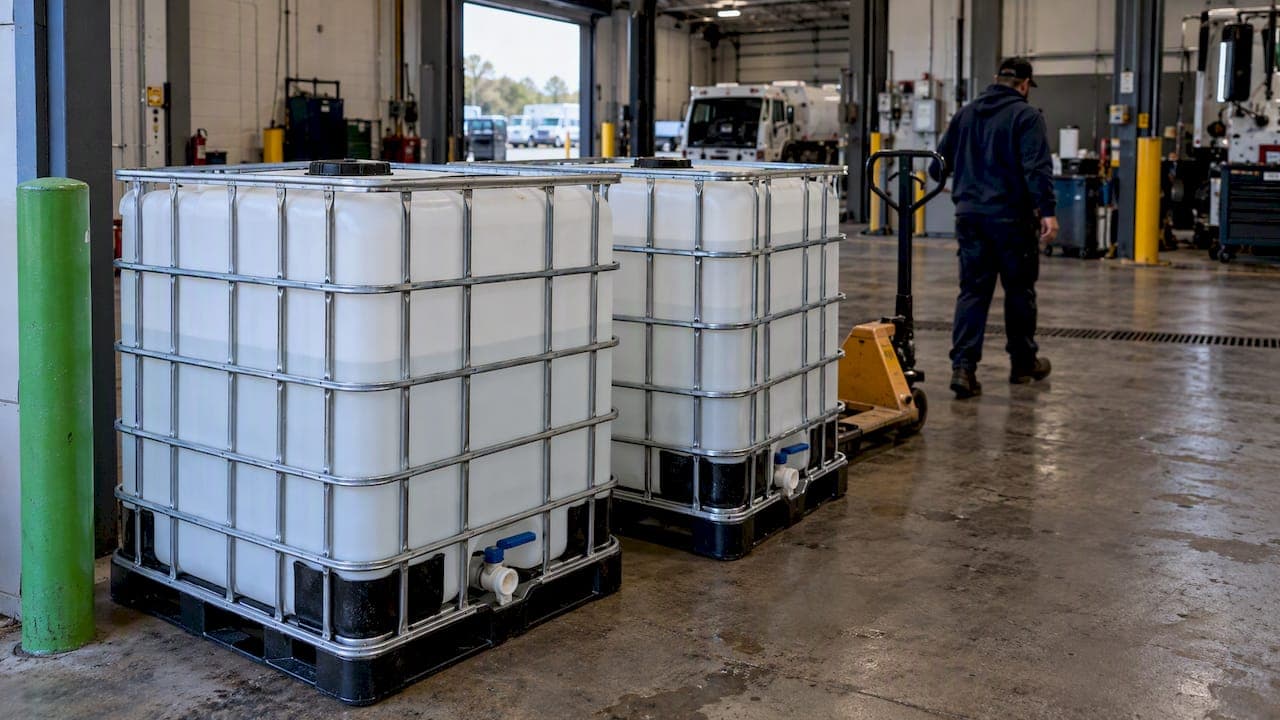
- Container format. Bulk tanker, 275 or 330-gallon IBC tote, or 55-gallon drum.
- Storage and dispensing support. Whether you need the supplier to supply or maintain tanks and dispensers.
- Qualification evidence. Past performance, financial stability and proof of insurance.
Leaving these out is how bids come back unusable, or how a buyer ends up with a product that technically meets the price but not the operation. Tenders may also require dedicated, clean, certified delivery equipment so that the fluid is not cross-contaminated in transit.
Choosing a container format
| Format | Typical use | Main advantage | Main watch-out |
|---|---|---|---|
| 55-gallon drum | Small yards, low volume | Easy to place and move | Highest handling and per-gallon cost |
| 275/330-gallon tote | Mid-size fleets, remote sites | Flexible, no fixed tank needed | More handling, returnable-tote logistics |
| Bulk tank with dispenser | High-volume fleets, agencies, depots | Lowest per-gallon cost, fewest handling steps | Needs site setup and tank maintenance |
For high-volume users, API guidance on maintaining DEF quality points to on-site bulk storage as the more cost-effective and compliant approach compared with packaged containers. It cuts packaging waste and the manual steps where contamination tends to happen. Integrated tank and dispenser packages built to NFPA 30 are described there as the strongest option for mission-critical fleets.
How large buyers structure the contract
Bulk DEF is rarely bought as one-time purchase. Government and large commercial buyers typically use indefinite delivery/indefinite quantity (IDIQ) arrangements. You lock in pricing terms and supply stability, then order as needed.
The Maryland statewide contract for bulk fuel and diesel exhaust fluid is a public example. It is a five-year agreement. Contracts of this kind often include:
- Volume-based wholesale pricing.
- Dedicated account management.
- For large sites, supplier-installed and maintained storage such as IBC totes or bulk tanks.
- Minority business participation goals (the Maryland document cites 35%).
- Required certifications, including ISO 22241-1 and API licensure.
Award criteria frequently lean toward lowest price technically acceptable. That makes your specification even more important. If the technical bar is vague, the lowest price wins on paper and you carry the quality risk in the field.
Stock levels and local rules
Solicitations can add operational conditions. A transit authority bid, for example, required minimum on-site stock (two totes at each location) and compliance with local air quality requirements, as noted in the research on India's central eProcurement portal and similar tenders. Read these clauses early. They affect your supplier's logistics and your price.
Bidding on public DEF contracts
Government agencies buy DEF through eProcurement systems. In the United States that is SAM.gov, plus state and local bidding portals. Other countries run their own. In every case the pattern is the same:
- Register as a verified supplier on the portal.
- Monitor solicitations: tenders, RFPs, RFQs and IFBs.
- Prepare financial documentation, a quality assurance plan and compliance certifications.
- Submit by the stated closing date and time. Late submissions are rejected.
If you are a buyer, this tells you what to expect from a supplier: an active registration, documented procedures and evidence of past performance. If you are a supplier, it tells you that a missed deadline cannot be recovered.
Shelf life: how much can you buy at once?

Shelf life is where procurement and storage meet. Buy too much for your storage conditions and you carry waste. Buy too little and you pay for frequent deliveries.
The API storage and handling fact sheet gives the temperature-dependent guideline:
| Constant storage temperature | Shelf life |
|---|---|
| 50°F (10°C) or below | 36 months |
| 77°F (25°C) or below | 18 months |
| 86°F (30°C) or below | 12 months |
| 95°F (35°C) or below | 6 months |
Above 95°F, test the product before use. These are constant-temperature figures. A white paper from a DEF manufacturer notes that a site that swings between hot days and cool nights lands somewhere between the values, so a warehouse that reaches 95°F in the afternoon may give you anywhere from six to eighteen months.
Two practical points follow:
- Plan by your hottest storage location, not your average. A tote on a sunny yard in Oklahoma in August behaves differently from a tank in a shaded building.
- Do not forget vehicles. API notes that fleets often overlook DEF already in the vehicle tank. If a vehicle sat unused more than 12 months, or was exposed to prolonged extreme heat, API experts recommend draining and replacing the fluid.
Some practitioners argue the calendar is conservative. The same manufacturer white paper says DEF is more stable than the guidelines suggest, and that evaporation and contamination are the main risks rather than age. We read that as a reason to manage inventory actively with FIFO, not as a reason to ignore the guideline for contracts and warranties.
Storage and handling requirements
Good storage protects what you paid for. The basics:
- Keep it out of direct sunlight and heat. The API fact sheet lists sun and high temperatures as things to avoid because they accelerate degradation.
- Do not add aftermarket additives to DEF. The same sheet warns they may harm quality.
- Use compatible materials. DEF is corrosive to carbon steel, aluminum, magnesium, copper and alloys containing zinc, lead or solder. Cummins recommends containers made of polyethylene, polypropylene or Grade 316 stainless steel.
- Dedicate your equipment. Generic pumps, funnels and drums introduce contamination. Closed-loop storage and dispensing is the standard for avoiding airborne and material contamination.
- Leave room for expansion. DEF expands about 7% when it freezes, so never fill containers to the brim. It can freeze and thaw without losing quality once fully thawed, per the API tips page.
For a full set of tank and dispenser practices, the Petroleum Equipment Institute publishes Recommended Practices for the Storage and Dispensing of DEF (RP1100). Use it as the reference when you write site requirements into a contract.
A procurement checklist
Before you issue an RFQ or sign a supply agreement, confirm:
- The specification names ISO 22241 and API certification.
- Every delivery site, volume and container format is listed.
- The supplier's delivery equipment is dedicated to DEF.
- Storage is sized to your hottest site's shelf life, with FIFO built into the reorder routine.
- Pricing terms say how they track the market, and how often they are refreshed.
- Counterparties are verified and documentation is retained for audit.
- Responsibilities for tank installation, maintenance and inspection are written down.
Our perspective
Most DEF problems we see described in procurement documents are paperwork problems before they are product problems. A bid that leaves out the container format, the sites or the certification gets answered with a price that cannot be compared, and then the buyer discovers the gap after delivery.
We approach DEF the way we approach every fuel and lubricant category: start from the buyer type. A local fleet needs fast, repeatable delivery. A public agency needs documentation that holds up to audit. An international buyer needs verified counterparties and clear terms. The product may be the same fluid, but the procurement path is not.
Two principles guide our work. First, quotes should rest on live market data, not last quarter's numbers. Second, every procurement should be compliance-ready: screened counterparties and complete records. We are SAM.gov active and an Oklahoma OMES approved supplier, and we hold to the same documented process on commercial orders as on public ones.
On storage, our advice is plain. Buy for the shelf life your hottest site allows, keep equipment dedicated, and rotate stock. Do that and DEF is one of the more forgiving products in a fleet's supply chain.
— Destin Metoyer
Working with Nuntius on DEF supply
Nuntius Logistics Intelligence is a Tulsa-based procurement firm for bulk fuel, lubricants and additives, including DEF, for commercial businesses, government buyers, international traders and local fleets. You get one point of contact, market-aware pricing, verified counterparty screening and documentation. We handle logistics coordination and recurring resupply so deliveries match your usage. Public-sector buyers can see how we work as a prime contractor on our government procurement page. To discuss a DEF requirement, start from our main site and send us your sites, volumes and container format.
FAQ
How long does DEF last in storage?
It depends on temperature. The API fact sheet gives 36 months at or below 50°F, 18 months at or below 77°F, 12 months at or below 86°F and 6 months at or below 95°F. Above 95°F, test it before use. Keep it shaded and rotate stock first in, first out.
What are the DEF storage requirements for a fleet yard?
Use sealed, dedicated containers or tanks made of compatible materials such as polyethylene, polypropylene or 316 stainless steel. Keep them out of direct sun and avoid carbon steel, aluminum, copper and zinc alloys. Leave headroom because DEF expands about 7% when frozen.
Does freezing ruin DEF?
No. DEF freezes at 11°F and returns to normal once fully thawed, because urea and water thaw in the same proportions. Do not fill containers completely, and do not add anything to it to prevent freezing.
What should a DEF RFQ include?
State ISO 22241 compliance and API certification, delivery locations, estimated annual volume, container format (bulk, tote or drum) and any storage or dispensing support you need. Add past performance, financial and insurance requirements for bidders. Incomplete specifications are a common reason bids are rejected or deliveries disappoint.
How do government agencies buy DEF?
Through eProcurement portals such as SAM.gov and state or local systems, using RFQs, RFPs and IFBs. Suppliers register first and must meet closing deadlines. Large buyers often use IDIQ contracts so that orders follow actual need.
Sources
- API: Storage and handling of diesel exhaust fluid fact sheet
- API: DEF tips to keep a diesel-powered vehicle running smoothly
- API: How to maintain DEF quality
- DEF heating and cooling effect on product quality and shelf life (white paper)
- DEF tank winterization flyer and FAQ
- Maryland statewide contract for bulk fuel supply and DEF
- Fort Bend County, Texas diesel exhaust fluid solicitation
- India central eProcurement portal
- Cummins: DEF quality and maintenance
- PEI: Recommended practices for storage and dispensing of DEF (RP1100)