
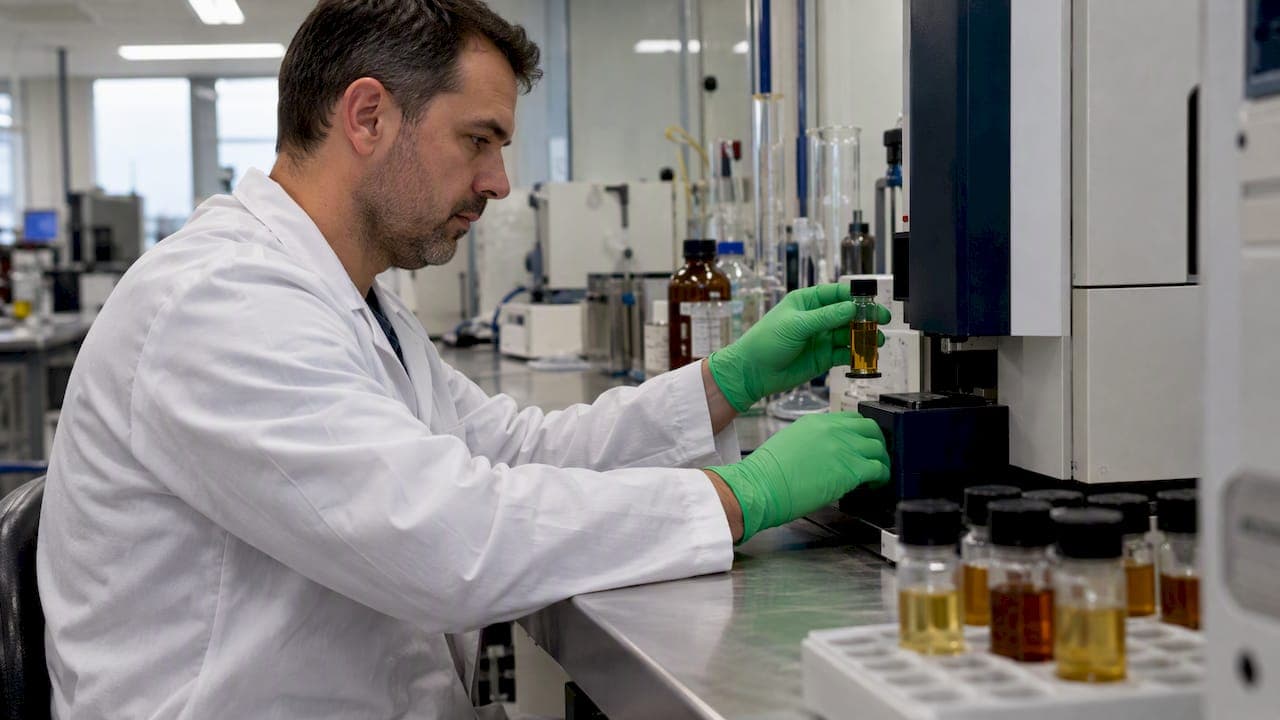
Fuel quality testing measures a sample against a written specification, and the result is only as good as the sample and the paperwork behind it. For diesel in the United States, that specification is usually ASTM D975. The tests that matter most are sulfur, flash point, cloud point, cetane and lubricity. If the result may ever be used in a dispute, the sample must be taken by a recognized method and carry a documented chain of custody.
This guide is for fleet managers, facility operators, public buyers and traders who purchase fuel in bulk. It covers what the ULSD specifications say, how diesel sample testing works, where results go wrong, and how to write testing into a purchase so you are not arguing about quality after delivery.
TL;DR
- ASTM D975 divides diesel into grades by sulfur class. Ultra low sulfur diesel is the S15 class, with a maximum of 15 ppm sulfur.
- A lab result is only as reliable as the sample. Use ASTM D4057 for manual sampling and mix or check the tank for stratification first.
- A screening kit tells you the condition of fuel you already own. Only a properly sampled, documented test supports a claim against a supplier.
- Write the spec, the test methods, the sampling point and the dispute procedure into the purchase order or contract before delivery.
Table of Contents
- What fuel quality testing actually covers
- ULSD specifications: reading ASTM D975
- Diesel sample testing: how it works
- Screening kits versus certified testing
- Building testing into the purchase
- Our perspective
- Where we can help
- Common mistakes to avoid
- FAQ
- Sources
What fuel quality testing actually covers
The term covers three different jobs, and mixing them up leads to buying the wrong test.
- Specification testing. Does the product meet the standard it was sold under? This is the job of a buyer receiving a delivery, or a regulator checking a seller.
- Condition monitoring. Has the fuel in your tank degraded, picked up water or been contaminated? This is routine maintenance for generators, fleets and storage sites.
- Forensic testing. Something went wrong: injector failures, filter plugging, a failed inspection. You need results that stand up with a supplier, an insurer or an agency.
The lab methods overlap, but the sampling and documentation requirements do not. Specification and forensic testing demand strict procedure. Condition monitoring can be more relaxed, provided you do not treat the result as proof of anything.
Regulators think about it the same way. The NIST handbook for fuel and oil quality officials describes quality programs as a way to provide an official presence in the marketplace and to verify that sellers have control systems in place. For a commercial buyer, the useful lesson is that independent, documented results are your main evidence if you ever need to dispute quality.
ULSD specifications: reading ASTM D975
ASTM D975 covers seven grades of diesel fuel oil. According to the current edition of the standard, they are Grade No. 1-D and Grade No. 2-D, each in S15, S500 and S5000 sulfur classes, plus Grade No. 4-D for low and medium speed engines. The S number is the maximum sulfur content in parts per million: 15, 500 or 5000.
When buyers say ULSD, they mean the S15 class, most often Grade No. 2-D S15. It is the grade modern on-road engines with exhaust aftertreatment are designed for. One technical guide notes that S15 fuel is required for most modern engines with particulate filters and SCR systems, because higher sulfur can poison catalysts.
The properties you will see on a spec sheet
Compliance with D975 is determined by testing a set of critical parameters. These are the ones you will see most often, and what each tells you.
| Property | What it tells you | Type of risk |
|---|---|---|
| Sulfur | Environmental compliance and aftertreatment protection | Regulatory, emissions equipment |
| Flash point | Temperature at which vapors can ignite | Safety and insurance |
| Cloud point | Temperature at which wax begins to form | Cold-weather operability |
| Cetane number | Ignition quality | Starting, combustion smoothness |
| Lubricity | Protection of pumps and injectors | Wear, component life |
| Water and sediment | Contamination | Filter plugging, corrosion, microbial growth |
| Distillation | Boiling range of the fuel | Performance and consistency |
One technical summary puts the cetane number requirement at 40 or higher for most grades. Check the current edition of the standard for the exact limit that applies to the grade you buy.
Not every test measures engine performance
A common misconception is that every parameter reflects how the engine will run. The Nevada Department of Agriculture's diesel testing program lists the parameters it checks against ASTM D975. Flash point is mainly a safety and insurance measure, because it relates to fire hazard, not to power or economy. Cetane and lubricity speak more directly to performance.
This matters when you decide what to monitor. A fleet that runs in winter should watch cloud point and water. A storage site with insurance requirements should keep flash point records. A buyer under contract needs the full set named in the purchase specification.
What a buyer's specification looks like in practice
Public and utility buyers show the format well. A published ULSD specification attached to a utility request for proposals lists each test item with its units, its limit and its ASTM method. Appearance, gravity, copper strip corrosion and distillation are each tied to a named method. Some properties are marked as report only, meaning the supplier reports the value without a pass or fail limit.
Copy that structure. A good specification has four columns: property, limit, test method, and who pays if the result fails.
EN 590 for international cargoes
If you buy diesel for export markets, the reference is often EN 590 instead of ASTM D975. One laboratory summary of EN 590 diesel analysis lists cetane number and index, density, distillation, sulfur, flash point, cold filter plugging point, lubricity and water and sediment among the measured parameters. The overlap with D975 is large, but the limits and some methods differ. State which standard governs the cargo, and do not assume the two are interchangeable.
Diesel sample testing: how it works
A diesel sample goes to a laboratory, where technicians run the methods named in your specification. Results come back as a report listing each property, the method used and the value found.
What happens before the sample reaches the lab decides whether the report is useful.
Sampling is where results fail
The most common pitfall is poor sampling. Examples include drawing from a tap that was not flushed, using a dirty container, or taking fuel from a spot that does not represent the tank. Each introduces contamination or fuel that is not representative.
The ASTM standard itself is clear on this. The text of D975 states that correct sampling procedures are critical and points to Practice D4057 for manual sampling and D4177 for automatic sampling. It also notes that contaminants and degradation products usually settle to the bottom of a still tank, so a bottom or clearance sample can tell you something a top sample will not. A copy of the D975-24 text carries this guidance.

If you want to rely on a result, take the sample under ASTM D4057 and record how you did it. The NIST handbook says manual sampling of dispensers and storage tanks should follow the latest ASTM procedures.
Check the tank for stratification
Fuel in a tank can form layers with different properties, especially after a delivery or a temperature swing. A sample from one level may mislead you.
The EPA's guidance on sampling storage tanks is written for reformulated gasoline, but the logic carries over to any tank. It uses gravity testing to confirm homogeneity before certification sampling, with a maximum difference of 0.6 °API between upper, middle and lower samples. The EPA page also treats visibly different samples from different depths as a sign the tank is not homogeneous. Take that as a practical rule. If the top and bottom samples look different, mix the tank or sample at several levels before drawing conclusions.
Chain of custody
Chain of custody is a documented record of who held the sample from collection to analysis. The NIST handbook explains why it matters: it shows the sample was not tampered with, substituted or altered. Without it, laboratory results may carry little weight in a legal or administrative proceeding.
A workable chain-of-custody record includes:
- Date, time and location of sampling
- Tank, truck or vessel identification and the sampling point
- Sampling method used, for example ASTM D4057
- Name of the person who drew the sample
- Seal numbers on each container
- Each handover, with signatures and dates
- Retained sample for the other party, where the contract allows
Timing
Fuel changes and stocks turn over. A report from last quarter says little about what is in the tank today. After a suspected contamination event, sample straight away and do not wait for the next maintenance window. Treat any older result as a historical record, not as a description of current fuel.
Screening kits versus certified testing
Mail-in kits have a place. A diesel test kit from an independent oil analysis laboratory was listed at $85.00 in the continental United States, with shipping both ways included. It runs a spectral exam, flash point and other checks to determine fuel condition.
That is useful for an operator who wants to know whether stored fuel has picked up water or been mixed with gasoline. It is not a substitute for specification testing. The lab states that it does not provide ASTM certification for cetane rating or biodiesel identification. A kit sample drawn by an employee, with no seals and no chain of custody, will not carry weight in a claim.
Use this rule of thumb:
| Situation | Right approach |
|---|---|
| Routine check of stored fuel | Screening kit or lab condition test |
| Receiving a bulk delivery under a spec | Sample at delivery under D4057, full spec panel, sealed retains |
| Suspected contamination, no claim planned | Immediate sampling, lab panel on suspect properties |
| Possible claim against supplier or warranty dispute | Documented chain of custody, accredited lab, spec methods |
| Government or public contract | Follow the solicitation's test and sampling clauses exactly |
Building testing into the purchase
Most quality disputes start because the contract was silent. The buyer assumed one standard, the supplier another, and nobody agreed who samples, where, or what happens on a failed result.
Before you issue a purchase order or accept a quote, settle these points in writing:
- Governing specification. Name the grade and standard, for example ASTM D975 Grade No. 2-D S15, or EN 590 with the sulfur class.
- Test methods. List the method for each property, as the utility specification above does.
- Sampling point and method. Say whether samples are taken at the loading point, at your tank or both, and under which procedure.
- Retained samples. Agree who keeps sealed samples and for how long.
- Independent laboratory. Name the lab or the rule for choosing one, and who pays.
- Tolerance and failure. State what happens if a result is out of limit: rejection, price adjustment, replacement, or retest.
- Timing. Set a window for testing and objections after delivery.
- Documentation. Require a certificate of quality and delivery paperwork with each load.
For government buyers, much of this is set by the solicitation. Read the quality clauses before you bid or evaluate offers, since they often name methods and acceptance criteria.
Our perspective
We source bulk fuel, lubricants and additives for commercial fleets, government agencies and international buyers, and the same pattern shows up across all of them. Quality problems are rarely mysteries of chemistry. They are gaps in documentation.
A buyer who has the spec, the method, the sampling point and the paperwork agreed before the load moves can settle almost any question in a day. A buyer who has only a price can end up arguing about it for months.
That is why we treat procurement as more than finding a seller. Our quotes are based on live market data, so the price you see reflects today's market, not last quarter's. Counterparties are screened and verified, and the documentation is built to hold up. We are SAM.gov active and an Oklahoma OMES approved supplier, so public buyers can rely on us to work inside the rules their solicitations set.
Our advice to any buyer, whether or not you buy through us, is to decide the test plan at the same time as the order. Ask what the product must meet, who verifies it and what you will have in hand if the answer is no. If you cannot answer those three questions, do not sign yet.
— Destin Metoyer
Where we can help
If you buy diesel, heating oil, lubricants, DEF or additives in bulk, we can help you write the specification and documentation into the procurement. For recurring needs, our logistics coordination and recurring resupply services keep delivery and paperwork consistent from one load to the next. Public agencies can review our prime-contractor fulfillment offering, and international buyers can see our EN590 diesel, Jet A1 and sulphur listings. To discuss a requirement, start at nuntiusintelligence.com. We do not publish prices, because every quote is built on live market data for your product, volume and delivery point.
We do not serve individuals or retail fuel customers.
Common mistakes to avoid
- Sampling from a gauge tube or an unflushed tap. The sample will not represent the fuel in the tank.
- Sampling one level of an unmixed tank. Stratification can make one sample misleading.
- Relying on an old report. Fuel in a tank changes, and a report from an earlier delivery does not describe today's fuel.
- Treating a screening kit as proof. It tells you condition. It does not certify cetane or establish a claim.
- Testing everything, or nothing. Match the tests to the risk: cloud point for cold-weather fleets, flash point for insured storage, sulfur for emissions-regulated equipment.
- Skipping the chain of custody. A result without a record of who held the sample may be worthless in a dispute.
FAQ
How do you test diesel fuel quality?
Take a representative sample using ASTM D4057 for manual sampling, seal it and record who handled it. Send it to a laboratory to run the methods named in your specification. For routine monitoring, a mail-in condition kit can screen for water, flash point and gasoline contamination, but it will not certify a specification.
What is the sulfur limit for ultra low sulfur diesel?
Under ASTM D975, the S15 class has a maximum of 15 ppm sulfur. The S500 and S5000 classes allow 500 and 5000 ppm. Check the current edition of the standard and the rules that apply to your engines and location.
How much does diesel sample testing cost?
It depends on the panel. One independent laboratory listed a condition-monitoring diesel kit at $85.00 in the continental United States, with shipping included. A full specification panel with documented chain of custody costs more, and the price depends on the lab and the methods you require.
Is two-year-old diesel still good?
It may or may not be. Storage conditions, water and contamination matter more than age alone. Sample the tank properly and test for the properties you care about, such as water and sediment, flash point and sulfur, before you decide to use or discard it.
Does flash point show how well an engine will run?
No. Flash point is mainly a safety and insurance measure related to fire hazard. Properties such as cetane number and lubricity speak more directly to engine performance.
Sources
- ASTM D975 Standard Specification for Diesel Fuel
- NIST Handbook 158: Field Sampling Procedures for Fuel and Motor Oil Quality Testing
- US EPA: How should storage tanks be sampled for RFG?
- Nevada Department of Agriculture: Diesel Testing Program
- Blackstone Laboratories: Diesel Fuel Test Kit
- Ultra Low Sulfur Diesel specification, utility RFP attachment
- EUROLAB: Diesel Analysis, EN 590 / ASTM D975
- Understanding ASTM D975: A Practical Guide
- ASTM D975-24 text, NCWM supporting document